Skip to Content
Medart Engine University
  • Home
  • Education
    • Courses
    • Education Sign-up Form
  • Community
    • Tech Hub
    • Technician Forum
    • Blog
    • Events
  • Technical Services
    • Technician Help Portal
    • Tecumseh/LCT Warranty Form
    • SBD/ MTD Warranty Authorization Request
  • Contact us
  • ​ 0
  • +1 636.231.3326
  • English (US) Português (BR) Español (América Latina)
  • Sign in
  • Contact Us
Medart Engine University
  • ​ 0
    • Home
    • Education
      • Courses
      • Education Sign-up Form
    • Community
      • Tech Hub
      • Technician Forum
      • Blog
      • Events
    • Technical Services
      • Technician Help Portal
      • Tecumseh/LCT Warranty Form
      • SBD/ MTD Warranty Authorization Request
    • Contact us
  • +1 636.231.3326
  • English (US) Português (BR) Español (América Latina)
  • Sign in
  • Contact Us
  1. Courses
  2. MEU Hydro-Gear 3100 Series Teardown & Inspection Review
  3. Lesson 2.1: The Variable Displacement Pump
Nav
Home └MEU Hydro-Gear 3100 Series Teardown & Inspection Review └Lesson 2.1: The Variable Displacement Pump

MEU Hydro-Gear 3100 Series Teardown & Inspection Review

0 %

Completed

Course content
  • Section 1: Introduction to the IHT
    • Lesson 1.1: What is an IHT?
  • Section 2: The Hydraulic Heart
    • Lesson 2.1: The Variable Displacement Pump
    • Lesson 2.2: The Fixed Displacement Motor
  • Section 3: From Hydraulic Power to Wheel Power
    • Lesson 3.1: The Gear Train & Differential
    • Lesson 3.2: Supporting Components
    • Knowledge Check: Hydro-Gear 3100 10 xp

Lesson 2.1: The Variable Displacement Pump

Prev Next
Fullscreen Share
This is the most critical part of the system. It explains how speed and direction are controlled.

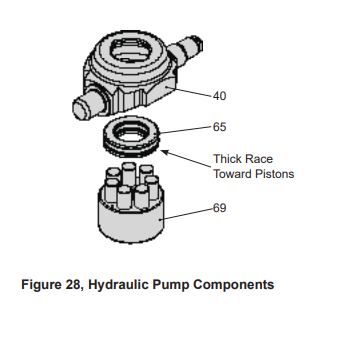
This is the "sending" unit, connected to the engine by a belt and pulley. It's an axial piston pump.

Inside, a set of pistons move back and forth inside a rotating cylinder block.

The key component is the swashplate. The operator controls the angle of this plate with the speed control pedal or lever.
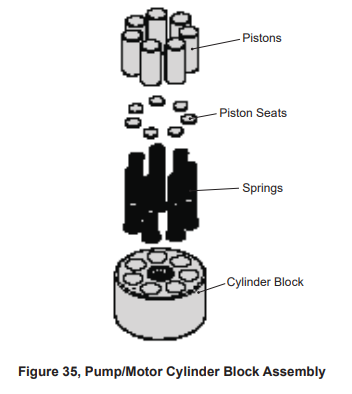
  • Neutral: When the swashplate is perfectly vertical (90∘ to the pistons), the pistons just spin around without pumping any fluid. The wheels don't move.

  • Forward: When you press the forward pedal, the swashplate tilts. This tilt forces the pistons to pump oil out as they rotate. The steeper the angle, the more oil they pump, and the faster the mower goes.

  • Reverse: Pressing the reverse pedal tilts the swashplate in the opposite direction, reversing the flow of oil and making the mower move backward.

Analogy: Think of the swashplate like the pitch control on a helicopter's rotor. A flat pitch (neutral) creates no lift. Tilting the blades (the swashplate) creates lift (oil flow).

  • About
  • Comments (0)

Rating
0 0

There are no comments for now.


Copyright © Medart Engine University 2026
English (US) | Português (BR) | Español (América Latina)
Powered by Odoo - Create a free website