
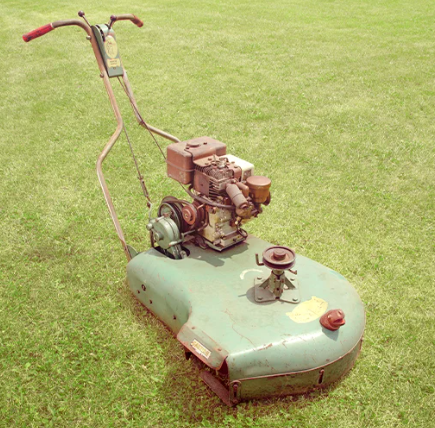
The history of Snapper traces back to 1894 with the founding of Southern Saw Works in Georgia. As the regional timber industry slowed in the 1940s, business owner William Raymond Smith acquired the company—then operating as McDonough Power Company—and began looking for new manufacturing directions. Recognizing the rapid growth of post-WWII American suburbia and the rising demand for residential lawn care tools, Smith purchased a patent for an innovative rotary mowing blade design in 1950. By 1951, the company launched the "Snappin' Turtle," one of the earliest self-propelled rotary lawnmowers. Named both for its clean grass-snapping cut and the iconic cast-iron turtle figurine mounted on its front deck, the machine immediately set the foundation for the brand.
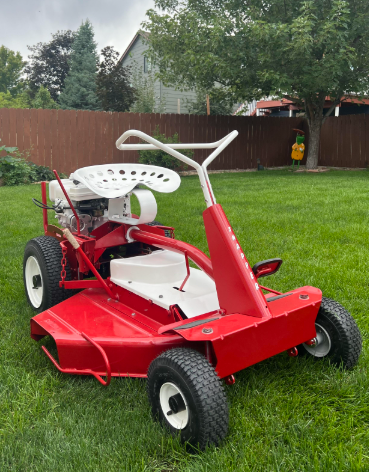
Throughout the 1960s and 1970s, McDonough Power Equipment fully embraced its flagship brand identity, officially renaming the corporation Snapper. During this era of expansion, the company designed what would become its most legendary machine: the Snapper Rear Engine Rider. Built with an uncluttered tubular steel chassis, an engine mounted behind the operator for superior visibility, and a famously durable friction-disc drive transmission, the Rear Engine Rider became a staple on suburban lawns across North America. The brand further solidified its reputation among mechanics and homeowners with the introduction of its Hi-Vac walk-behind mowers, which utilized a rolled-lip deck design to generate maximum lift and vacuum-like bagging efficiency.
By the late 1980s and 1990s, Snapper had grown into a massive manufacturing force with major operations centered in McDonough, Georgia. Its bright red, easily serviceable lawn equipment became deeply ingrained in American pop culture, most famously highlighted in the 1994 Academy Award-winning film Forrest Gump, where the title character regularly mowed lawns aboard a classic Snapper Rear Engine Rider. Beyond lawn mowers, the manufacturer broadened its catalog to include heavy-duty rototillers, snow blowers, lawn tractors, and commercial zero-turn mowers, maintaining a strict independent dealer network known for high-touch service and long-lasting parts support.
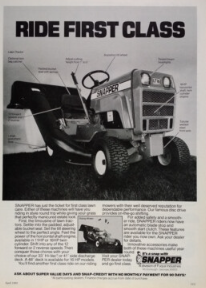
The 2000s marked a major transition period in ownership and distribution philosophy for the brand. Snapper was acquired by Simplicity Manufacturing in 2002, which was subsequently purchased by engine giant Briggs & Stratton in 2004. While early corporate leadership fiercely protected the brand's premium status by refusing to sell through big-box mass retailers, later corporate shifts saw Snapper expand into large retail chains alongside its traditional dealer base. Production was consolidated over time as the outdoor power equipment market rapidly shifted toward complex hydrostatic drives, zero-turn platforms, and battery-powered equipment.
Although production lines and brand licensing have evolved significantly over recent years, Snapper’s legacy remains firmly intact within the small engine and equipment community. Millions of classic Snapper rear-engine riders and Hi-Vac walk-behinds remain in active service today, prized by collectors, technicians, and DIY mechanics for their rugged simplicity, readily available parts, and straightforward mechanical design. The story of Snapper stands as a testament to 20th-century American manufacturing ingenuity, showing how a simple blade patent grew into an enduring icon of suburban lawn care.
For a comprehensive video breakdown of the brand's rise, mechanical evolution, and manufacturing history, The Rise and Fall of Snapper Mowers provides a detailed documentary overview covering the company's early roots through its corporate transitions.