
SBD/MTD FLA vs. AGM Batteries: Why Your Old Shop Charger Is Killing New Batteries
Coming out of 2024 into 2025, our dealership in Missouri ran into a handful of issues with the Cub Cadet 725-17335 battery across multiple equipment lines. While our yard crew did occasionally miss checking the torque on the battery hardware, we began to suspect a deeper issue with the battery design itself: a style known as AGM.
AGM stands for Absorbent Glass Mat. At first, we didn't know much about them other than the fact that they were smaller. If you find yourself in the same boat, keep reading—because your customers are likely wishing they had read their owner's manual, or at least the warning on top of the battery stating that this style requires a specialized charging process.
The Science: Why Standard Chargers Fail AGM Batteries
Little did we know, the shop charger we had relied on for years was skipping a critical step.
A standard Flooded Lead Acid (FLA) charger operates on a basic profile: it pushes electrons into the battery until it detects that it is "full," and then it abruptly shuts off.
Reading publication (SBD-006) for dealers from Stanley Black and Decker we learned more...
AGM batteries are fundamentally different. They have much lower internal resistance than standard FLA batteries, meaning they require a structured, multi-stage smart charging profile:
Bulk Charge: Rapidly bringing the battery up to about 80% capacity.
Absorption (The "Soak" Time): Holding a constant voltage while slowly tapering the current, allowing the electrons to deeply saturate the glass mats.
Float Charge: Dropping to a lower voltage to maintain a safe, full charge.
Our old shop charger wasn't allowing for that crucial Absorption "soak" time. It would blast the AGM battery, deliver a quick surface charge, and shut down.
Our technicians would connect a multimeter, read a healthy 12+ Volts, and assume the battery was ready to go. But by the time the customer got the equipment home, that superficial surface charge had dissipated, dropping the battery right back into a low or completely dead state.
The Solution for Shops and Customers
To eliminate these callbacks, we had to modernize our charging equipment.
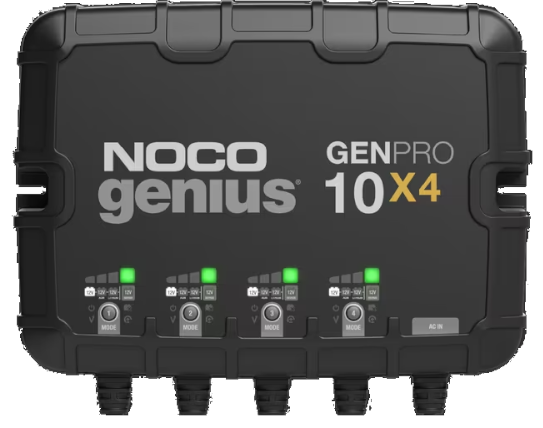
For Shop & Yard Applications: We adopted the NOCO GENPRO10X4 (shown above). This commercial smart charger allows us to properly charge up to four batteries independently at the same time in the shop. Because it is completely waterproof, our yard crew can take it right out to the staging area to prep new equipment as it's assembled, without us worrying if a sudden downpour ruins the tool (not that tools ever get left out in the rain).
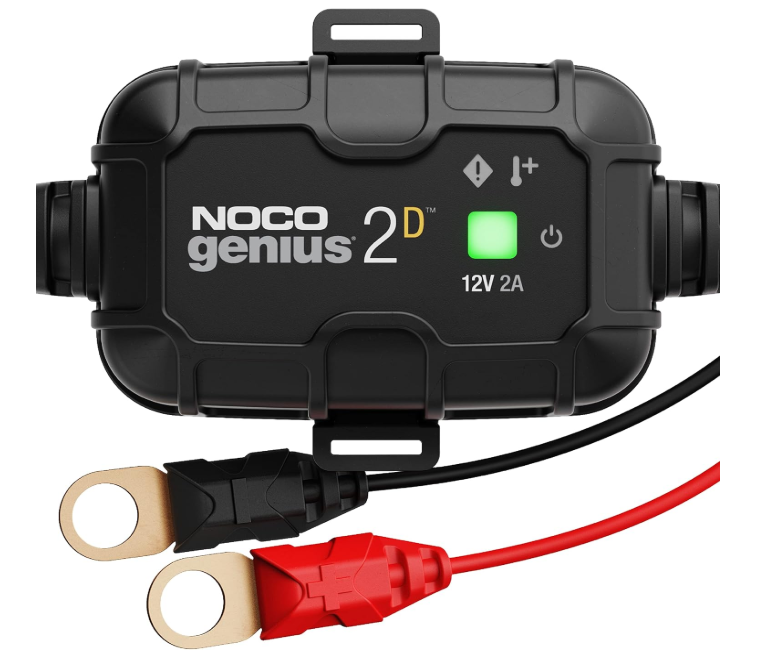
For Our Customers: We now explicitly recommend the NOCO Genius2D onboard charger and maintainer. At under $60, it’s an affordable, set-it-and-forget-it solution that any homeowner can easily operate to keep their AGM battery in peak condition during the off-season.
After discussing this with dozens of technicians over the past year here at Medart Engine University, it's clear that this exact charging confusion is incredibly common across the industry. Upgrading your chargers to match modern battery technology is the fastest way to save your shop time, money, and unneeded headaches.